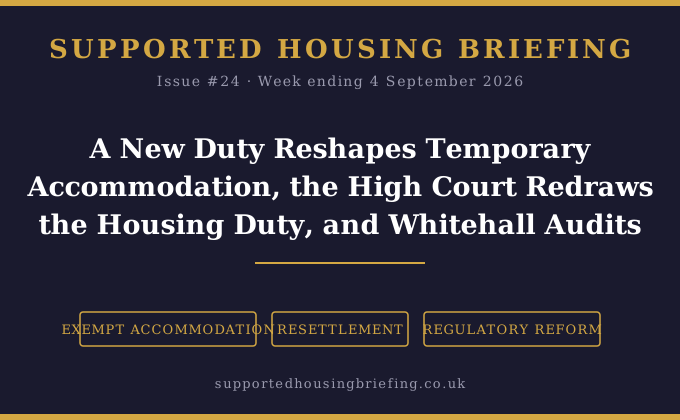
A New Duty Reshapes Temporary Accommodation, the High Court Redraws the Housing Duty, and Whitehall Audits Its Own Reforms
Five developments, most relevant to supported housing providers and local authorities this week.*
1. New statutory temporary accommodation duty comes into force
A new statutory duty governing local authorities' use of temporary accommodation has come into force in England, reshaping how councils discharge their homelessness functions under Part VII of the Housing Act 1996. The duty tightens obligations around the suitability, review and management of temporary accommodation placements at a time when TA use is at record levels and council budgets are under acute strain. For the supported housing sector the significance is structural: the legal boundary between temporary accommodation (funded under ordinary Housing Benefit rules) and supported "exempt" accommodation (which sits outside the Local Housing Allowance cap) is a persistent area of dispute. Any duty that changes how authorities place, review and fund temporary accommodation will influence whether councils lean further on the exempt-accommodation pathway as a parallel route. Source: Inside Housing
2. High Court ruling on the council housing duty to "influence homelessness decision-making for years"
The High Court has handed down a judgment on the scope of the local authority housing duty that Inside Housing reports will "influence homelessness decision-making for years to come." Rulings on how councils discharge the main housing duty under Part VII of the Housing Act 1996 — including the tests for suitability, priority need and vulnerability — carry direct downstream consequences for supported and exempt accommodation, which authorities routinely use as a discharge route for vulnerable applicants. Where a judgment tightens the circumstances in which duty can be discharged into the private rented or supported sector, or clarifies the vulnerability threshold, providers and commissioners must re-examine referral and placement practices. The full judgment should be obtained and read against existing suitability and allocation policies. Source: Inside Housing
3. HMPPS publishes Interim Pre-Release Policy Framework
HM Prison and Probation Service has published an Interim Pre-Release Policy Framework setting out the role of pre-release teams and Commissioned Rehabilitative Services (CRS) in delivering the in-custody element of resettlement. A substantial cohort of supported exempt accommodation residents are released prisoners, and the interface between HMPPS resettlement commissioning, Housing Benefit entitlement and providers' care-and-support obligations is a recurring source of legal complexity. Any change in how pre-release teams engage with housing providers — and which accommodation is treated as suitable for resettlement — feeds directly into Housing Benefit eligibility assessments and providers' due-diligence duties. The "interim" designation signals a transitional document pending fuller reform, so providers holding CRS-linked or CAS3 contracts should read it now and track the successor framework. Source: Gov.uk
4. MHCLG commissions value-for-money evaluation of social housing reforms
The Ministry of Housing, Communities and Local Government has appointed a firm to conduct a formal value-for-money evaluation of the social housing reforms enacted in recent years — work that will almost certainly encompass the Social Housing (Regulation) Act 2023 and the consumer regulation regime now applying to registered providers, including those operating exempt accommodation. Commissioning an external evaluator at this stage suggests government is assembling an evidence base ahead of spending-review decisions on the Regulator of Social Housing's resourcing, local authority oversight capacity, and the pace of Supported Housing (Regulatory Oversight) Act 2023 implementation. For supported housing providers, the scope and terms of reference matter: a VfM finding that consumer regulation is under-resourced could accelerate — or a critical finding could slow — the licensing and oversight architecture the sector is preparing for. Source: Inside Housing
5. 60% of London's first-wave SAHP cash to flow directly to councils
Inside Housing reports that around 60% of London's first-wave allocation under the Social and Affordable Homes Programme (SAHP) — the successor capital programme to Homes England's Affordable Homes Programme — will be directed to local authorities rather than to housing associations or specialist providers, with allocations expected "in coming months." This marks a material shift of commissioning power toward councils at a time when many borough-level frameworks for supported housing remain underdeveloped. For exempt accommodation providers, the concern is whether council-led SAHP spending prioritises mainstream affordable housing over specialist supported provision, and what procurement and sub-contracting models will govern specialist delivery. If the council-heavy model is replicated in Homes England's non-London allocations, it could reshape who develops and controls supported housing stock for the programme period. Source: Inside Housing
Deep Dives
Deep Dive 1 — The new temporary accommodation duty and the exempt-accommodation boundary: why the definitional battle just got sharper
The arrival of a new statutory temporary accommodation (TA) duty in England is being read, understandably, as a homelessness story. For supported housing practitioners it is something more precise: a fresh pressure on the fault line between temporary accommodation funded under ordinary Housing Benefit rules and "supported exempt accommodation" funded outside the Local Housing Allowance (LHA) cap. That fault line is not a matter of policy preference. It is drawn by Schedule 3 paragraph 4(10) of the Housing Benefit and Council Tax Benefit (Consequential Provisions) Regulations 2006, which preserves the pre-2008 definition of exempt accommodation and turns on whether care, support or supervision is provided to the claimant by, or on behalf of, the landlord. Every time a new duty changes how authorities place and fund the vulnerable, it changes the incentives to characterise a placement as one side of that line or the other — and it is the characterisation, not the label on the door, that determines subsidy.
The analytical difficulty is that a single building can be temporary accommodation for one resident and exempt accommodation for another, depending entirely on the support relationship. The new TA duty tightens suitability, review and management obligations on councils at a moment when TA use is at record levels and general-fund subsidy on TA is heavily restricted. That combination creates a structural temptation: reclassify marginal placements as "supported" to escape the LHA cap and recover full eligible rent through Housing Benefit subsidy. The exempt-accommodation gateway is precisely where that temptation has historically been tested, and it is where authorities and providers most often get the law wrong.
The controlling authorities are the Turnbull line of Commissioners' and Upper Tribunal decisions — CH/150/2007, CH/4432/2006, CH/200/2009 and R(H) 4/09. Together they establish that the care, support or supervision must be "more than minimal" to bring accommodation within the exempt definition, and that it must be connected to the provision of the accommodation rather than incidental to it. This is not a box-ticking exercise satisfied by a support plan in a filing cabinet. A resident placed in a building because they are homeless, who happens to receive light-touch signposting, is not thereby in exempt accommodation. The "more than minimal" threshold requires a genuine, identifiable, ongoing support function that would not exist but for the landlord's arrangements. Where the new TA duty pushes councils to place larger volumes at speed, the risk is that support is retrofitted to placements that are, in substance, temporary accommodation — and that is a subsidy exposure waiting to be found on audit.
Bristol City Council v AW sharpens the point with the "real difference" test: the support provided must make a real difference to the claimant's ability to live in the accommodation, judged against what the claimant would receive anyway. This is the analytical tool that separates genuine supported housing from repackaged TA. It asks not "is there support?" but "does this support, provided by or on behalf of this landlord, materially change this person's capacity to sustain this tenancy?" Applied honestly, it disqualifies a great deal of accommodation that is marketed as supported. Applied to the placements the new TA duty will generate, it is the question every commissioning officer and every provider finance director should be asking before a claim is submitted — because it is the question the subsidy auditor will ask afterwards.
There is a tension between the decisions that practitioners must hold in mind. The Turnbull "more than minimal" threshold is a floor: it screens out trivial or incidental support. The Bristol "real difference" test is qualitative and relational: it asks whether the support is causally connected to the claimant's ability to occupy. The two are not identical, and a placement can clear the first while failing the second — support that is more than minimal in volume but makes no real difference to occupation. The new TA duty, by increasing throughput, will multiply exactly these borderline cases. Providers who assume that "more than minimal" is the whole test will find that clearing it is necessary but not sufficient.
For local authorities the duty creates a governance problem as much as a legal one. Discharging the TA duty into accommodation that is later held not to meet the exempt definition does not merely risk subsidy loss; it exposes the authority to challenge on suitability and to the reputational and regulatory consequences of placing vulnerable people in provision that is neither properly supported nor properly regulated. The Regulator of Social Housing's consumer standards now bite on registered providers operating in this space, and the Supported Housing (Regulatory Oversight) Act 2023 is building a licensing architecture precisely to stop expedient, unscrutinised expansion of "supported" provision under demand pressure. The new TA duty and the SHROA 2023 framework are, in effect, pulling in opposite directions unless authorities are disciplined about classification.
The practical implications are concrete. First, every placement generated under the new duty should be assessed against the Schedule 3 paragraph 4(10) definition on its own facts, not by reference to the scheme's general label. Second, providers should document the support relationship in terms that speak directly to the Turnbull threshold and the Bristol "real difference" test — who provides the support, on whose behalf, and what it changes. Third, finance teams should treat the LHA-cap escape as a legal conclusion to be earned on the facts, not a funding assumption to be built into a model. The new duty does not move the exempt-accommodation boundary. It simply guarantees that more placements will be pressed against it — and that the cost of getting the classification wrong will rise.
Deep Dive 2 — HMPPS pre-release reform and the "who provides the support" question for resettlement accommodation
HMPPS's Interim Pre-Release Policy Framework looks, on its face, like an operational document about prison resettlement. For the supported housing sector it reopens one of the most litigated questions in Housing Benefit law: when accommodation is provided to a released prisoner alongside resettlement support, is that support provided "by or on behalf of the landlord" so as to bring the accommodation within the exempt definition — or is it commissioned rehabilitative activity that runs in parallel to a bare tenancy? The answer determines whether the placement escapes the Local Housing Allowance cap, and it is an answer the framework makes more urgent by formalising the role of pre-release teams and Commissioned Rehabilitative Services (CRS) in the in-custody resettlement pathway.
The governing definition remains Schedule 3 paragraph 4(10) of the Housing Benefit and Council Tax Benefit (Consequential Provisions) Regulations 2006. It is not enough that a resident receives support; the support must be provided by the landlord or by someone acting on the landlord's behalf, and it must be connected to the provision of the accommodation. Resettlement models frequently fail this test not because support is absent but because it is delivered by a probation-commissioned third party under a contract with the Ministry of Justice or HMPPS — not with, or on behalf of, the landlord. Where the CRS provider and the accommodation provider are legally and operationally distinct, the "on behalf of the landlord" limb is where claims collapse.
This is the precise ground of Allerdale Borough Council v JD [2019] UKUT 304. The Upper Tribunal's analysis turns on the relationship between the landlord and the party delivering the support: support provided by an independent body, under its own commissioning arrangements and duties, is not automatically support provided "on behalf of" the landlord merely because it is delivered to the landlord's tenants in the landlord's building. There must be a genuine agency or arrangement under which the support is provided for the landlord. Applied to the HMPPS framework, the reform makes this harder, not easier, to satisfy: the more clearly resettlement support is located within CRS and pre-release team structures accountable to HMPPS, the more clearly it sits outside the landlord's provision. Providers who have historically leaned on the presence of resettlement workers in their schemes to justify exempt status should treat the interim framework as a warning that the support they rely on may be contractually someone else's.
The Turnbull decisions — CH/150/2007, CH/4432/2006, CH/200/2009 and R(H) 4/09 — supply the second gate. Even where support is genuinely provided by or on behalf of the landlord, it must be "more than minimal." Resettlement accommodation for ex-offenders often involves intensive support in the first weeks after release, tapering rapidly. That trajectory creates a real analytical problem: the support may comfortably clear the "more than minimal" threshold on the day of admission and fall below it within months, even as the tenancy and the exempt-status claim continue. Housing Benefit is assessed on the facts as they stand, and a snapshot that was accurate at intake does not license an assumption that the accommodation remains exempt throughout. Providers must be able to show a sustained, more-than-minimal support function, not a front-loaded one that has since evaporated.
Bristol City Council v AW and its "real difference" test is where these strands meet. The question is not whether an ex-offender receives resettlement help in the abstract, but whether the support provided by or on behalf of *this* landlord makes a real difference to *this* person's ability to occupy *this* accommodation. Resettlement support that addresses offending behaviour, employment or substance misuse may be valuable and may satisfy MoJ objectives without making the requisite difference to the person's capacity to sustain the tenancy — which is the difference the exempt definition cares about. The tension between what HMPPS commissions support to achieve (reduced reoffending) and what Housing Benefit law requires support to achieve (sustained occupation) is the analytical heart of the issue, and the interim framework, by sharpening the rehabilitative purpose of CRS, arguably widens the gap between the two.
The practical implications for providers are significant. First, the framework should prompt a contractual audit: who, in law, provides the support in each resettlement scheme, under what arrangement, and can that arrangement be characterised as provision "on behalf of the landlord" within the Allerdale analysis? If the support is CRS-delivered under an HMPPS contract with no agency relationship to the landlord, the exempt claim is fragile. Second, providers should map the support trajectory against the Turnbull threshold across the life of the placement, not merely at intake, and be ready to evidence continuing more-than-minimal support. Third, the Bristol "real difference" test should be applied to the *housing* function of the support specifically — separating resettlement outcomes from occupation-sustaining outcomes in the records.
For local authorities, the framework is a subsidy-risk signal. Councils that place released prisoners into schemes claiming exempt status inherit the exposure if the support relationship does not meet Schedule 3 paragraph 4(10). And the Supported Housing (Regulatory Oversight) Act 2023, with its licensing and standards architecture, will increasingly require authorities to look behind the label at the substance of the support — the same substance the exempt definition has always demanded. The HMPPS reform does not change the law. It changes the factual landscape against which the law is applied, and it does so in a direction that makes the "on behalf of the landlord" and "real difference" questions harder to answer in providers' favour. Schemes built on the assumption that any resettlement worker on site secures exempt status should be re-examined now, before the interim framework becomes the settled commissioning model.
Deep Dive 3 — The VfM evaluation, the stakeholder survey and SHROA 2023: reading the regulatory reform trajectory
Two items in a single week — MHCLG commissioning a value-for-money (VfM) evaluation of the social housing reforms, and the Regulator of Social Housing publishing its 2026 stakeholder survey — look like routine machinery of government. Read together, they are a signal about the direction of supported-housing regulation, and specifically about how much enforcement capacity the sector should expect the state to fund. For providers of supported exempt accommodation, the regulatory trajectory is not an abstraction: it determines the pace at which the Supported Housing (Regulatory Oversight) Act 2023 licensing regime is implemented, the resourcing of the RSH's consumer standards work, and the appetite of local authorities to look behind the "supported" label at the substance of provision.
The analytical starting point is that the VfM evaluation and the survey are evidence-gathering exercises, and evidence-gathering precedes decisions about money and reform. Commissioning an external evaluator to assess the social housing reforms — almost certainly encompassing the Social Housing (Regulation) Act 2023 and the consumer regulation regime — at this stage suggests government is building the case it will need for spending-review choices about the RSH's resourcing and about local authority oversight capacity under SHROA 2023. The stakeholder survey supplies the perception data that will sit alongside the VfM findings. The question for the sector is whether these exercises will conclude that consumer regulation is under-resourced (arguing for acceleration) or that it is delivering poor value (arguing for retrenchment). Either conclusion reshapes the environment in which exempt accommodation providers operate.
Here the legal knowledge base matters, because SHROA 2023 does not exist in a vacuum. Its purpose is to give local authorities and the RSH the tools to stop expedient, unscrutinised expansion of "supported" provision — the same problem that Housing Benefit law has policed for two decades through the exempt-accommodation definition. Schedule 3 paragraph 4(10) of the Housing Benefit and Council Tax Benefit (Consequential Provisions) Regulations 2006 already requires that care, support or supervision be provided by or on behalf of the landlord; the Turnbull decisions (CH/150/2007, CH/4432/2006, CH/200/2009, R(H) 4/09) already require it to be "more than minimal"; and Bristol City Council v AW already asks whether the support makes a "real difference." SHROA 2023 layers a licensing and standards regime on top of a subsidy definition that has always demanded substance over label. The VfM evaluation will, in effect, be assessing whether the newer regulatory architecture is adding value to a legal framework that already contains a robust substance test — and whether the two are aligned or duplicative.
The tension the sector should watch is between the subsidy test and the regulatory standard. The exempt-accommodation definition polices *funding*: it asks whether accommodation qualifies for Housing Benefit outside the LHA cap. The RSH consumer standards and the SHROA 2023 licensing regime police *quality and conduct*: they ask whether provision is safe, well-governed and genuinely supportive. These are different questions with different remedies, and a provider can satisfy one while failing the other. A scheme may clear the Turnbull "more than minimal" threshold for subsidy purposes yet breach the consumer standards on safety and tenant voice; conversely, a well-run scheme may find its exempt status challenged on the Bristol "real difference" test even where its regulatory compliance is exemplary. The VfM evaluation is an opportunity — and a risk — precisely because it may recommend aligning these regimes, which would change the compliance burden for every provider in the space.
For providers, the practical implications are about anticipating rather than reacting. First, the "real difference" standard from Bristol CC v AW is becoming, in substance, a quality proxy as well as a subsidy test: the same evidence that a scheme's support materially changes residents' ability to occupy is the evidence that the support is genuine for consumer-standards purposes. Providers who build their support records around that test are hardening themselves against both subsidy audit and regulatory inspection. Second, the SHROA 2023 licensing regime, once implemented, will require providers to demonstrate the same substance — the by-or-on-behalf-of-the-landlord support, more than minimal, making a real difference — that the exempt definition demands. Aligning internal evidence to a single substance standard is the efficient response to a converging regulatory environment. Third, the VfM evaluation's terms of reference should be tracked closely: whether the RSH survey data is broken out by provider type, and whether supported housing features specifically, will indicate whether the sector is being assessed on its own terms or folded into a general social-housing analysis that misses its distinctive risks.
For local authorities, the convergence is a governance signal. Councils are simultaneously the subsidy gatekeepers (through Housing Benefit administration and the exempt-accommodation test) and the emerging licensing authorities under SHROA 2023. A VfM finding that oversight capacity is inadequate would land squarely on local government, which has historically lacked the resource to interrogate the support substance behind exempt claims. The Allerdale BC v JD [2019] UKUT 304 analysis — that support must genuinely be provided on behalf of the landlord — is exactly the kind of substantive scrutiny that under-resourced authorities struggle to apply at scale, and it is exactly the scrutiny SHROA 2023 is meant to systematise.
The overall reading is that the state is assembling the evidence base for a decision about how much supported-housing regulation to fund and how tightly to integrate it. The sector cannot influence the VfM conclusion, but it can prepare for the most likely outcome: a regulatory environment in which the subsidy substance test and the quality standards converge on a single question — is the support real? Providers who can answer that question with documented, sustained, more-than-minimal, landlord-connected support that makes a real difference will be well-placed whichever way the evaluation lands. Those relying on the label will not.