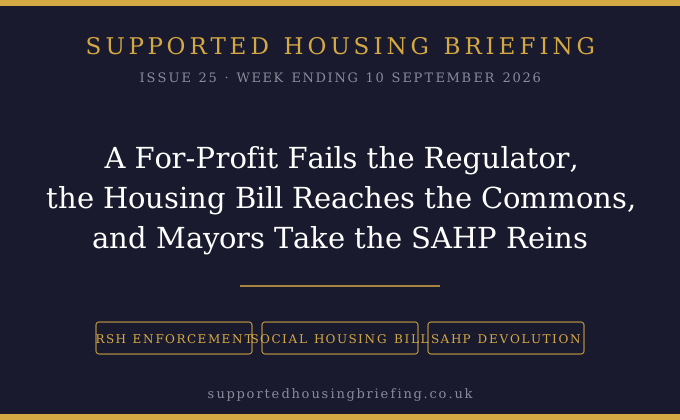
A For-Profit Fails the Regulator, the Social Housing Bill Reaches the Commons, and Mayors Take the SAHP Reins
Top 5 this week
1. RSH finds for-profit CIC non-compliant in 9 September judgements batch
The Regulator of Social Housing published a batch of regulatory judgements on 9 September 2026, finding for-profit Community Interest Company Keystage C.I.C. non-compliant with regulatory standards. The finding lands as the provider is reported to be exploring a merger, raising unsettled questions about how non-compliance is managed through a change-of-control process. Judgements on specialist supported-housing provider Look Ahead Care and Support Limited and on Melton Borough Council were published in the same batch. For-profit CICs are heavily represented among exempt-accommodation providers, and a non-compliance finding carries governance, viability and — where Housing Benefit is claimed at exempt rates — potential local-authority and DWP review consequences. The batch signals continued RSH enforcement pressure on the for-profit supported-housing cohort.
2. Social Housing Bill reaches Commons Second Reading with domestic-abuse tenure provisions
The Social Housing Bill [HL] 2026-27 reached its Second Reading in the House of Commons this week, with the Chartered Institute of Housing publishing a briefing on 8 September 2026. The briefing highlights provisions designed to make it easier for domestic-abuse survivors to remain in their homes and retain security of tenure. The measures are directly material to supported housing: many refuges operate under exempt-accommodation rules, and changes to tenure security for survivors will interact with the licence and short-tenancy structures common across supported settings. As a live legislative vehicle at an early Commons stage, the Bill may attract supported-housing-specific amendments touching housing benefit, the definition of “support,” or local-authority oversight. Providers and advisers should begin tracking Committee-stage timetabling now.
3. Mayors to gain control of SAHP funding as CME becomes the residual route
Housing Minister Matthew Pennycook confirmed this week that mayors and combined authorities will gain greater control over Supported and Affordable Housing Programme (SAHP) funding — a structural shift in how supported-housing supply is grant-funded and commissioned regionally. Homes England’s chief executive separately urged providers that missed the main allocation round to apply via the Continuous Market Engagement (CME) route, now the primary residual access mechanism, while Steve Rotheram indicated the Liverpool Mayoral Development Corporation will be operational by month-end. For providers operating across multiple mayoral areas, the change points to a more fragmented funding landscape with divergent regional priorities and accountability lines. Councils and providers should watch for a formal policy paper setting out how devolved SAHP control interacts with Homes England’s remaining CME functions.
4. Crime and Policing Act housing and ASB provisions commence 26 October 2026
Commencement regulations published this week confirm that key housing and anti-social behaviour provisions of the Crime and Policing Act will take effect on 26 October 2026 — under seven weeks away. ASB management is a core element of the “more than minimal” support test that underpins exempt-accommodation Housing Benefit claims, so the incoming powers and duties are directly material to supported-housing providers, commissioners and local authorities. Providers should review the commencement statutory instrument for any new landlord obligations or changes to possession and injunction frameworks affecting supported settings. With the date now fixed, sector guidance from MHCLG and the Regulator is anticipated over the coming weeks, and providers should ensure ASB policies and staff training are updated ahead of commencement.
5. RSH Q1 survey: cash interest cover at record low, majority of providers forecasting deficit
The Regulator of Social Housing’s Q1 2026 Quarterly Survey, covering April–June and published 3 September 2026, shows cash interest cover among private registered providers at a record low, with more than 70% of landlords forecasting they will spend more than they bring in. Bulk asset sales are rising as providers seek liquidity. For supported housing the picture is directly material: exempt-accommodation and supported-housing income streams are Housing Benefit-funded and already under pressure from local-authority benefit decisions. A sector-wide squeeze on reserves and covenant headroom raises the systemic risk of provider failure and may accelerate consolidation or market exit by financially stretched providers — with smaller, non-RP exempt operators outside the survey potentially more exposed still.
Deep Dives
Deep Dive 1 — When the non-compliant provider wants to merge: enforcement, change of control, and the fragility of exempt status
The Regulator of Social Housing's 9 September finding that Keystage C.I.C. is non-compliant would be unremarkable but for one fact reported alongside it: the provider is said to be eyeing a merger. That combination — a non-compliance grade and a change of control in motion — exposes how little settled law governs what happens to an exempt-accommodation operation when its corporate skin is about to change.
Start with the foundation that practitioners too often skate over. Exempt-accommodation status is not a creature of the Housing Benefit Regulations 2006 proper; it is preserved by Schedule 3 paragraph 4(10) of the Housing Benefit and Council Tax Benefit (Consequential Provisions) Regulations 2006, which carries forward the pre-2006 definition. That definition has two limbs. The first is a landlord condition: the accommodation must be provided by a non-metropolitan county council, a housing association, a registered charity or a voluntary organisation. The second is a support condition: that body, or someone acting on its behalf, must provide the claimant with "care, support or supervision."
The landlord condition is where a for-profit CIC becomes legally interesting. A community interest company can be limited by shares and can distribute profit within the asset-locked CIC framework — and a body that operates for profit is not obviously a "voluntary organisation," which the authorities treat as a body that is not carried on for profit. Many for-profit exempt operations therefore do not hold the exempt landlord role themselves; they lease stock to, or manage on behalf of, a non-profit registered provider or charity that supplies the tenancy and nominally the support. A non-compliance finding against the CIC is a prompt to ask which entity in the structure actually satisfies paragraph 4(10) — because if it is a fragile non-profit shell whose independence the RSH now doubts, the exempt designation of every unit may be more precarious than the rent account suggests.
The support condition compounds the fragility. Bristol City Council v AW established the "real difference" test: support counts only where it makes a real difference to the claimant's ability to occupy and sustain the accommodation, judged on the facts at the time of the claim. The Turnbull line — CH/150/2007, CH/4432/2006, CH/200/2009 and R(H) 4/09 — holds that the support must be more than minimal and must be connected to the provision of the accommodation rather than being generic welfare activity floating free of the tenancy. Crucially, entitlement is assessed on present arrangements, not historic ones. So when control changes, the local authority is entitled — indeed obliged — to re-examine whether "care, support or supervision" is still being delivered to the required standard by a body that still satisfies the landlord condition.
This is why a merger is not a neutral event for exempt status. There is no doctrine that the exempt designation "transfers" with the stock. If the acquirer restructures support delivery, thins staffing to realise merger efficiencies, or interposes a different corporate vehicle, each is a live ground for the authority to supersede awards under the ordinary supersession rules. Allerdale BC v JD [2019] UKUT 304 is the cautionary text: it scrutinises arrangements structured to maximise Housing Benefit and confirms that tribunals will look past the paperwork to whether genuine, more-than-minimal support is actually provided. A merger executed to rescue a distressed, non-compliant provider is exactly the kind of arrangement in which form and substance may diverge.
Overlay the regulatory machinery. Under the Supported Housing (Regulatory Oversight) Act 2023, the direction of travel is toward national standards and local-authority licensing of supported housing, tightening the gap between "registered and graded" and "genuinely delivering support." The RSH consumer standards — in particular the Governance and Financial Viability expectations bearing on registered acquirers — mean the RSH's consent and scrutiny functions are engaged by a change of control involving a non-compliant party. The practical result is a two-key problem: the RSH controls whether the merged entity is a fit registered provider, while dozens of billing authorities independently control whether each unit remains exempt for HB purposes. Neither key turns the other.
The benefits-side exposure is wider than Housing Benefit alone. Where residents are on Universal Credit, housing costs for genuine exempt accommodation are met through Housing Benefit rather than the UC housing element, so the "specified accommodation" and exempt gateways determine which department pays and at what rate. A change of control that disturbs the support substance can therefore ricochet across both HB and UC casework, and a local authority that concludes the accommodation is no longer exempt may not simply reduce future awards but revisit past periods — with overpayment consequences that attach to the provider where it misrepresented the support position. That is the scenario in which a distressed provider's merger becomes a live fraud-and-error question rather than a tidy corporate transaction, and it is why DWP referral sits so close to the surface of any non-compliance finding against an exempt operator.
For practitioners the implications are concrete. First, in any acquisition of a distressed exempt operator, due diligence must map every unit to the specific entity satisfying paragraph 4(10) and to documented, individualised support that meets the Bristol "real difference" threshold — not to a portfolio-level assertion. Second, LAs receiving notice of a change of landlord should treat it as a trigger for review rather than a formality, and should ask for current support plans, not legacy ones. Third, providers should sequence RSH consent and LA notification deliberately: securing regulatory consent to merge does nothing to preserve HB income if the support substance lapses in transition. The Keystage facts are a template for a scenario the sector will see repeatedly as financial stress drives consolidation — and the law governing the seam between enforcement, merger and exempt status remains conspicuously thin.
Deep Dive 2 — Anti-social behaviour powers and the "support" question: why the Crime and Policing Act commencement cuts both ways
When commencement regulations fixed 26 October 2026 for the Crime and Policing Act's housing and anti-social behaviour provisions, most sector commentary framed it as an operational readiness exercise: update policies, train staff, refresh possession and injunction procedures. That is right as far as it goes. But for exempt-accommodation providers the new powers carry a subtler and more dangerous edge, because the way a provider deploys ASB tools can strengthen or quietly undermine the very exempt status that funds the scheme.
The reason lies in the qualifying test. Exempt status under Schedule 3 paragraph 4(10) of the HB&CTB (Consequential Provisions) Regulations 2006 turns on the provision of "care, support or supervision." Providers frequently point to ASB management — curfews, behaviour agreements, warnings, intensive keywork with chaotic residents — as the "supervision" that lifts a scheme above bare accommodation. The instinct is understandable: in cohorts with offending histories, addiction or complex needs, managing behaviour genuinely is much of the daily work. The difficulty is that the case law is exacting about whose benefit the activity serves.
The Turnbull decisions (CH/150/2007, CH/4432/2006, CH/200/2009, R(H) 4/09) require support that is more than minimal and connected to the accommodation, and they distinguish support to the claimant from generic housing and estate management. Bristol City Council v AW sharpens this into the "real difference" test — the activity must make a real difference to this claimant's ability to occupy and sustain their accommodation. Enforcement action taken to protect neighbours, staff or the wider estate is, on that logic, estate management: legitimate, often required, but not "support" to the person against whom it is directed. So a provider that responds to the new statutory toolkit by leaning harder into injunctions, closure powers and possession — activity aimed outward, at protecting third parties — may be generating impressive ASB casework that does nothing to evidence support to the individual claimant, and in a marginal scheme could tip the balance against exempt status.
The tension runs the other way too, and this is where Allerdale BC v JD [2019] UKUT 304 earns its place. Allerdale warns tribunals to look behind arrangements dressed up to secure Housing Benefit. A provider cannot rebrand routine enforcement as "support" simply to shore up the exempt claim; the tribunal will ask what was actually done for the claimant and whether it made a real difference. The new powers increase the volume of enforcement paperwork, which increases the temptation to characterise it as support — precisely the move Allerdale exists to catch. The safest position is the honest one: ASB support is the individualised, planned work with the resident (de-escalation, trigger management, engagement with treatment, tenancy-sustainment coaching); ASB enforcement is the outward-facing use of statutory powers. Both are legitimate; only the former reliably counts toward paragraph 4(10).
There is a regulatory layer that must not be conflated with the benefits test. The RSH consumer standards, through the Neighbourhood and Community Standard, positively require registered providers to prevent and tackle anti-social behaviour and to cooperate with relevant partners. After 26 October the new powers become part of the toolkit the Regulator expects providers to use competently. But discharging a consumer-standard duty to tackle ASB is a regulatory obligation owed to communities; it is not the same thing as delivering "support" to a claimant for HB purposes. A provider can be fully consumer-standard compliant on ASB and still fail the Bristol "real difference" test on a given unit, and vice versa. Practitioners who treat the two frameworks as one will mis-advise on both.
The licence context deserves particular care because it changes how the new powers actually operate on the ground. A great deal of exempt supported accommodation is occupied under licence rather than tenancy, and the statutory ASB architecture — closure powers, injunctions, and the possession grounds — was largely designed with tenancies in view. Where occupation is by licence, some remedies are unnecessary (a licence can often be terminated on notice) while others engage different procedural safeguards, and the interaction with the provider's own safeguarding duties toward a vulnerable perpetrator can be acute. Using a closure power against a unit occupied by a resident with complex needs may simultaneously be a legitimate protective step for others and a failure of support toward the individual — and the two characterisations have opposite consequences for the exempt claim. It is an argument for deciding, deliberately and on the record, whether a given intervention is protective enforcement or part of a support plan, because the same act cannot be both for the purpose of paragraph 4(10). The Supported Housing (Regulatory Oversight) Act 2023 framework, as it matures into local-authority licensing, will increasingly expect providers to evidence exactly that distinction, and schemes that cannot will struggle under both the oversight regime and the benefits rules at once.
The practical programme for the next seven weeks follows from that separation. First, review the commencement statutory instrument for changes to the injunction, closure and possession frameworks that bear on licence-based supported occupation — many supported schemes occupy under licence, and the availability and mechanics of the new powers may differ from secure or assured settings. Second, restructure record-keeping so that individualised support work is documented distinctly from enforcement action; the exempt claim lives or dies on the former. Third, train frontline staff to understand that reaching for a statutory power is sometimes the correct safeguarding response but is not, by itself, evidence of support. Fourth, where a scheme's exempt rationale rests heavily on "supervision," commission a file-level check against the Turnbull and Bristol standards before the new regime changes staff behaviour. The commencement date is being read across the sector as a compliance deadline. It is also, for exempt-accommodation operators, a quiet test of whether they can tell the difference between supporting a resident and policing an estate — a distinction the Upper Tribunal has never been shy about enforcing.
Deep Dive 3 — Security of tenure for survivors meets the licence model: the Social Housing Bill's collision with exempt refuge provision
The Chartered Institute of Housing's 8 September briefing on the Social Housing Bill's Commons Second Reading drew attention to provisions intended to help domestic-abuse survivors remain in their homes and keep their security of tenure. As a matter of social policy the aim is unimpeachable. As a matter of supported-housing law it opens a fault line, because much refuge and move-on provision is deliberately structured to avoid security of tenure — and that structure is load-bearing for exempt-accommodation status.
The starting point is that refuges and a great deal of supported housing sit within exempt accommodation under Schedule 3 paragraph 4(10) of the HB&CTB (Consequential Provisions) Regulations 2006: a voluntary organisation or charity provides the accommodation together with "care, support or supervision." Occupation is typically granted by licence rather than tenancy. That is not an accident of drafting; it is doctrinally purposive. A licence keeps the accommodation tethered to ongoing support need, allows rapid move-on so that scarce refuge capacity turns over, and reinforces the characterisation of the scheme as supported rather than as ordinary housing. The licence model and the exempt rationale are mutually reinforcing: occupation exists because support is being delivered, and ends when it is no longer needed or appropriate.
Enhanced security of tenure for survivors pushes directly against that logic. If a survivor acquires a statutory right to remain that is decoupled from continuing support need, the accommodation can drift from "supported" to "settled" while the resident stays put. That matters because exempt status is assessed on the current provision of "care, support or supervision," judged by the Bristol City Council v AW "real difference" test and the Turnbull decisions (CH/150/2007, CH/4432/2006, CH/200/2009, R(H) 4/09). Those authorities are unanimous that support must be more than minimal, connected to the accommodation, and actually delivered — not a historical artefact of how the person first arrived. So a survivor whose crisis support has appropriately tapered but whose right to remain endures may occupy accommodation that no longer qualifies as exempt, even though nothing about the tenure has changed. The question that then bites is fiscal: exempt status carries the higher Housing Benefit eligible-rent treatment that funds the intensive-support cost base. If a unit ceases to be exempt because support has fallen away while occupation continues, the shortfall between the exempt rent and the ordinary eligible rent lands somewhere — on the provider's viability, on the local authority, or on the survivor.
Allerdale BC v JD [2019] UKUT 304 frames the risk from the other direction. Providers faced with a resident who now has a right to remain but a reduced support need must resist the temptation to manufacture support activity to preserve the exempt claim. Allerdale confirms that tribunals will look at what is genuinely provided and whether it makes a real difference; padding a support plan to match a static occupation is precisely the kind of arrangement it polices. The Bill therefore threatens to leave providers between two unpalatable positions: lose exempt status when support genuinely tapers, or invite an Allerdale-style challenge by inflating support to fit the tenure.
It is worth being precise about where the money moves, because the fiscal mechanics are what turn a doctrinal point into a boardroom problem. Exempt accommodation escapes the Rent Officer restrictions that cap eligible rent in the general and specified-accommodation cases, which is what allows a refuge to recover an eligible rent reflecting its intensive-support overheads. Strip a unit of exempt status mid-occupation and the eligible rent falls to be determined on the ordinary basis, often well below the service-heavy cost of running the scheme. The provider cannot lawfully make good the gap by relabelling ineligible support charges as rent, and the low-income survivor cannot absorb it. The shortfall therefore crystallises as a viability loss for the provider or a discretionary-housing-payment call on the authority, neither of which is a stable footing for a service the state wants to keep open. A tenure reform that quietly converts supported units into settled ones without a funding bridge is, in effect, an unfunded mandate on the sector.
The regulatory frame adds a further wrinkle rather than resolving it. The RSH consumer standards — notably the Tenancy Standard — are built around the grant and management of tenancies, yet licence-based supported occupation largely sits outside that model, and the Regulator's expectations on fair and appropriate tenure interact awkwardly with schemes designed around non-tenancy occupation. Meanwhile the Supported Housing (Regulatory Oversight) Act 2023 is moving the sector toward national standards and local-authority licensing that assume a clear line between genuinely supported provision and settled housing. A tenure reform that keeps survivors in situ irrespective of support need blurs exactly the line SHROA is trying to draw, and does so through a different Bill on a different track — a coordination problem the sector should flag now.
For practitioners the action points are precautionary but real. First, track the Bill's Committee stage for amendments that touch licence-based or exempt occupation specifically; the Second Reading provisions are drafted with mainstream social tenancies in view and may not carve out supported settings. Second, model tenure deliberately — where a right to remain may attach, providers should plan for the moment support tapers and the exempt rationale weakens, including move-on and re-designation pathways rather than allowing units to drift. Third, engage the interaction with SHROA implementation in consultation responses, because a survivor-protection measure and a supported-housing-oversight regime that pull in opposite directions will otherwise be reconciled, badly, at the coalface. The policy goal of keeping survivors safe in their homes is right. The unresolved question is what happens to a scheme's legal and financial foundations when the person is protected but the support — the thing that made it exempt in the first place — has done its job and moved on.